What does one share of Nebius buy? An NBIS share is a claim on the Dutch parent. What will be left for that share after Nebius builds, powers and replaces its machines?
FINANCIAL BASELINE October 6, 2026 / FIELD NOTES Company studies · No. 01
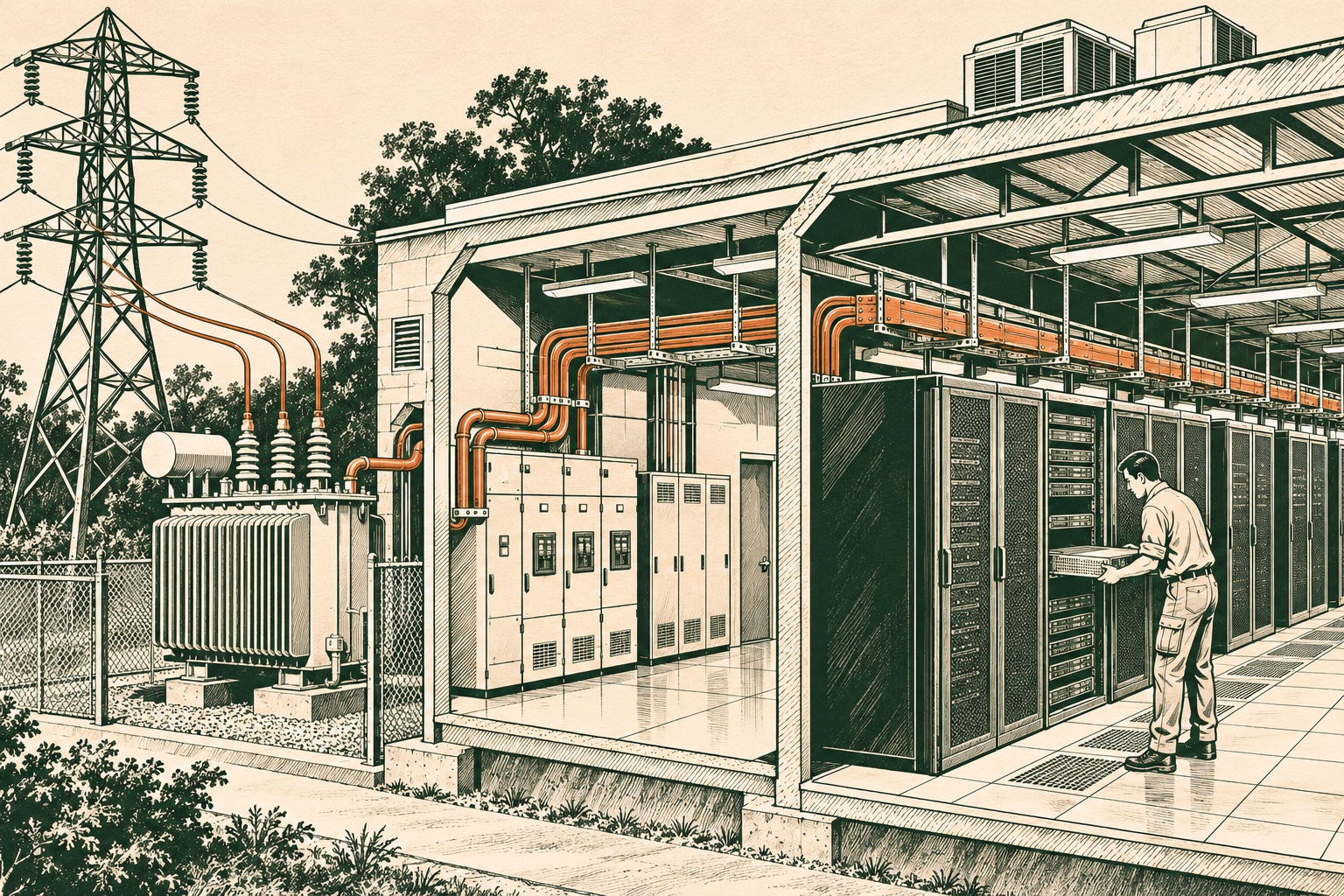
Fig. 01 / The machine room
Inside the AI buildoutConceptual illustration
The shareholder’s test
Can paid compute cover the next generation of machines and still leave cash for today’s shareholders?
Archive note
Financial baseline October 6, 2026. The November 3 briefing had no released company fair value. Later model experiments in this feature carry their own dates.
NEBIUS / INDEPENDENT INVESTOR BRIEFING
AI needs a
world to run on
Useful AI takes chips,
power and software.
October 6, 2026 financial baseline
CONCEPTUAL ILLUSTRATION
01
NBIS◆The Nebius StoryPlate 02 / 20
Prologue / The Russian origins
The engineering story began with Russian search
At Moscow’s Softool exhibition in September 1997, the Yandex team demonstrated a search engine for the Russian-language web.
Moscow · September 1997Historical reconstruction
01The work
Find a document even when the same Russian word appears in a different grammatical form.
02The lineage
Volozh later led Yandex and became principal founder of Nebius.
Field note
CompTek’s September 23 announcement listed a September 25 demonstration at stand D17 at Softool. The launch and venue are documented; the drawing reconstructs the booth and uses anonymous figures.
THE ORIGINS
Builders before
Nebius
Arkady Volozh and his future
Nebius co-founders built their
careers at Yandex in Russia.
F20, founder biographies and company history
CONCEPTUAL ILLUSTRATION
03
NBIS◆The Nebius StoryPlate 03 / 20
Prologue / The Russian origins
The Dutch parent sold its entire Russian business
Yandex N.V. sold the shares of IJSC Yandex, which held its Russian and certain related international businesses, to the Russian fund Consortium First.
AmsterdamMoscowMäntsäläEUROPE · 2024
Three locations in the separationMap · Natural Earth
01February 2024
The Dutch parent agreed to sell IJSC Yandex to Consortium First.
02May → July
The sale closed in two stages. Russia went to the buyer; the Finnish data center stayed with the Dutch group.
03August → October
The parent took the Nebius name in August. Nasdaq trading resumed on October 21.
Field note
The agreement was signed February 4 and announced February 5. Management dates the closings May 17 and July 12. Completion was announced July 15. The audit report uses May 16 when describing the divested subsidiary. Daily accounting cutoff remains unresolved.
THE DIVESTMENT
The 2024 break with Yandex’s Russian business
FEB
Deal announced
MAY
First closing
JUL
Final closing
AUG
Nebius name
OCT
Nasdaq trading
resumes
The Dutch parent continued. It sold the Russian and related businesses.
F20, Item 4 and financial statement notes. July 15, 2024 company announcement.
04
NBIS◆The Nebius StoryPlate 04 / 20
Prologue / The Russian origins
One Dutch share now represented a different business
A holder who kept a share owned the continuing Dutch parent. The sale brought the parent $2.8bn in cash and 162.5m of its own Class A shares, held in treasury.
Before: Yandex N.V. / Dutch listed parent
Sold to Consortium First
IJSC Yandex
The Russian businesses and certain related operations outside Russia went to the buyer.
Retained by the Dutch parent
Four international businesses
Nebius AI, Toloka AI, Avride and TripleTen, the Finnish data center, and minority investments.
A continuing shareholder still owned the parent. The parent received the sale proceeds: $2.8bn cash and 162.5m of its own Class A shares.
People carried experience. Roman Chernin brought search and maps experience; Andrey Korolenko brought infrastructure experience. Both became Nebius co-founders. The Russian operating businesses had been sold.
Field note
At closing, retained operations included Nebius AI, Toloka AI, Avride and TripleTen, plus the Finnish data center and minority investments. By the 2025 Form 20-F, the group reported stakes in Toloka and ClickHouse. Toloka was deconsolidated in May 2025.
THE FOUNDING TEAM
The team
reassembled
A shared engineering past.
A new infrastructure business.
Roman Chernin
Chief Business Officer
Arkady Volozh
Principal founder and CEO
Andrey Korolenko
Chief Product & Infrastructure Officer
CONCEPTUAL ILLUSTRATION
05
NBIS◆The Nebius StoryPlate 05 / 20
Chapter I / Selling computation
A customer pays to finish a job
A model can summarize a report only after software sends its tokens through a running cluster. Nebius sells access to the machines and software that do that work.
Fig. 01Request
Summarize this report.
Fig. 02Compute
Tokenize the input and run the model.
Fig. 03Result
Return the summary to the reader.
Field note
Training builds or adapts a model. Inference runs it on a request. A token is a piece of input or output. The same request can cost different amounts to serve depending on hardware, batching and response time.
THE AI WORKLOAD
Prompts become useful work
PROMPT
Summarize
this report
MODEL INPUT
Small pieces
of text
USEFUL OUTPUT
A summary
you can read
Summ
arize
this
report
Illustrative split
A token is a small piece of text a model reads or generates.
Training builds the model. Inference runs it to answer requests.
Plain-language example. F20, Item 4 and tokenizer documentation in notes.
02
NBIS◆The Nebius StoryPlate 06 / 20
Chapter I / Selling computation
Different sites put different costs on Nebius
From Amsterdam, the group expanded across the Atlantic. Building on owned land, commissioning a developer’s site and renting capacity place different obligations on the balance sheet.
Fig. 01Missouri
Greenfield. Nebius secured land and power for a site it would own.
Fig. 02Vineland, New Jersey
Build-to-suit. A developer supplies the site and Nebius specifies the facility.
Fig. 03Kansas City
Colocation. Nebius rents capacity in a third-party facility.
Field note
The August 2026 letter’s footprint included New Jersey, Missouri and Pennsylvania at different stages. A location on that map says little by itself about when a customer can use it.
GLOBAL OPERATIONS
A Dutch company builds out in the U.S.
NETHERLANDS
Amsterdam
Corporate base
UNITED STATES
U.S. build-out
New Jersey, Missouri, Pennsylvania
The August 2026 footprint shows sites at different stages of development.
F20 cover and Q2 2026 shareholder letter, capacity footprint.
06
NBIS◆The Nebius StoryPlate 07 / 20
Chapter I / Selling computation
Software turns a rack into a service
Customers can rent a cluster, use tools to schedule and monitor workloads, or ask Nebius to serve a model’s responses.
Fig. 01GPU compute
Chips, storage and fast links.
Fig. 02Cloud software
Allocate machines and monitor jobs.
Fig. 03Managed inference
Run a deployed model for users.
Field note
Networks and storage keep accelerators supplied with data. Cloud software allocates the cluster. Managed inference adds deployment and ongoing service. Each layer adds work for Nebius and changes what the customer buys.
THE PRODUCT
The token platform stack
03
Managed inference
Serve deployed models and handle production requests.
02
Cloud software
Allocate clusters, orchestrate jobs and monitor service.
01
GPU compute
Accelerator chips, fast networking and storage.
The ambition
Help customers finish demanding work reliably, then keep their models running.
F20, Item 4, lines 648–658 and 701–741.
07
NBIS◆The Nebius StoryPlate 08 / 20
Chapter I / Selling computation
The buyer can rent elsewhere or build its own cluster
A specialist must win on the cost and reliability of completed work. A low quoted GPU-hour rate alone does not tell the buyer how long its job will take.
Fig. 01Specialist cloud
CoreWeave, Crusoe, Lambda and Nebius.
Fig. 02Broad cloud platform
AWS, Google Cloud, Microsoft Azure and Oracle.
Fig. 03Customer-owned
The buyer purchases and operates the cluster.
Field note
Nebius identifies broad cloud platforms and specialist providers as competitors. Large customers can also operate their own infrastructure. These examples establish alternatives without estimating market share.
COMPETITION
Customers have three ways to get compute
Specialist clouds
CoreWeave, Crusoe, Lambda and Nebius offer specialist capacity.
Broad cloud platforms
AWS, Google Cloud, Microsoft Azure and Oracle bundle compute with wider cloud services.
Customer-owned clusters
Some buyers build and operate their own infrastructure.
Compare completed workloads on price, uptime, availability and ease of switching.
F20, competition, supplier risk and Microsoft agreement. No market-share estimate.
08
NBIS◆The Nebius StoryPlate 09 / 20
Chapter I / Selling computation
The contract decides who pays for idle time
On-demand use, a reserved cluster and managed inference can run on similar equipment. They expose Nebius to different revenue and service risks.
Fig. 01On demand
Sell usable time as customers request it.
Fig. 02Dedicated
Reserve capacity and meet availability terms.
Fig. 03Managed
Operate the model and deliver responses.
Field note
A dedicated reservation can pay for available capacity even when the customer uses less of it. Merchant revenue depends on paid demand. Managed service adds the cost of meeting the customer’s response and reliability requirements.
BUSINESS MODELS
Three ways to sell compute
01
On demand
Customers rent GPUs
when they need them.
02
Dedicated
Customers reserve clusters
for a contract term.
03
Managed
Customers pay for a service
that runs their models.
The product mix changes utilization, pricing and the cost of serving a customer.
Analyst framework informed by F20, Item 4, lines 701–744.
09
NBIS◆The Nebius StoryPlate 10 / 20
Chapter II / From power to cash
A powered rack still has to earn its first dollar
A grid connection energizes the site. Cooling, networking and commissioned GPUs make compute available. Commercial terms determine when that availability earns fees.
GridTransformerSwitchgearGPU racks
Power path · generic facilityConceptual cutaway
01Contracted
Land and power secured.
02Connected
Utility power reaches the facility.
03Installed → active
Racks are fitted. Active IT draws power and is available to earn revenue.
04Billable → cash
Dedicated service must meet contract terms. Merchant use must sell. Collection follows the billing schedule.
Field note
The issuer defines contracted, connected and active power. Installed equipment can still await commissioning. The November 6 Bull test assumes 8.07 GW of average available capacity in 2035 and $23.69m of annual owned fees per available MW, about $191bn in owned fees. Premium pricing and substantial financing are assumptions.
DELIVERY AND BILLABILITY
Power becomes revenue in stages
1
Contracted
Land and power
commitments
2
Connected
Utility power
reaches the site
3
Active IT
Installed machines
can run workloads
4
Accepted
Customer terms
determine billability
Track the time between each stage, then follow the cash collections.
F20, lines 662–675 and 2753–2755. Acceptance and collections are analyst distinctions.
10
NBIS◆The Nebius StoryPlate 11 / 20
Chapter II / From power to cash
Microsoft and Meta buy service with conditions attached
The contract totals span several years. Deployment, service levels and which capacity remains unsold determine the fees Nebius can earn.
Customer / order
Contract size · USD
Condition on the money
Microsoft
Up to about $17.4bn through 2031
Delivery and availability matter; service credits or tranche termination can follow a miss.
Meta / 2025
About $2.9bn initial order
The filing gives conflicting months for the first delivery.
Meta / 2026
$12bn dedicated + up to $15bn
The additional order applies to eligible capacity left unsold.
Field note
The August letter reported delivery of all Microsoft tranches. Service credits and termination rights remain material. For Meta’s initial order, Item 10 says the first delivery was in November 2025, while Note 2 says December. The precise month remains unresolved.
MICROSOFT AND META
Big customer contracts carry obligations
MICROSOFT
Up to about $17.4bn through 2031
Missed delivery or availability requirements can trigger credits or end a tranche.
META / 2025
Approximately $2.9bn initial order
First tranche month unresolved. The filing says November and December 2025 in different sections.
META / 2026
$12bn dedicated plus up to $15bn
The additional order depends on eligible capacity remaining unsold to other customers.
F20, lines 2753–2767 and 5747–5754. Contract values are multiyear and conditional.
11
NBIS◆The Nebius StoryPlate 12 / 20
Chapter II / From power to cash
AI cloud generated $574.9m of $582.3m in quarterly sales
In Q2 2026 nearly all group revenue came from AI cloud. The $3.0bn headline measured the pace of business at quarter end.
Realized revenue · Q2 2026 · USD millions
Group
AI cloud
The cloud figure is included in group revenue. The bars share a $0–600m scale.
A different measure · exit pace
$3.0bn
June AI cloud revenue × 12. An annualized run rate extrapolates one month.
Field note
USD. Group and AI cloud revenue cover the three months ended June 30. The annualized run rate multiplies June AI cloud revenue by twelve. Collections, capital spending and replacement cash follow different schedules.
REPORTED THROUGH JUNE 2026
The financial starting point
$582.3m
Group revenue
Q2 2026
$574.9m
AI cloud revenue
Q2 2026, included in group
$3.0bn
Annualized run rate
June AI cloud revenue × 12
Cash conversion still depends on customer receipts, investment and replacement funding.
Q2 2026 shareholder letter, p. 9 and p. 3 footnote 4. USD.
12
NBIS◆The Nebius StoryPlate 13 / 20
Chapter II / From power to cash
The bill for a GPU arrives before the customer’s cash
A batch of machines consumes cash at deposit, delivery and installation. Its useful life must earn back those costs and leave enough for replacement.
Fig. 01Before service
Fund the deposit, equipment and installation.
Fig. 02In service
Collect fees after credits. Pay for power, networks and operations.
Fig. 03At refresh
Continue, replace, redeploy or sell if terms allow.
Field note
Compare the whole cohort on dated cash flows. Allocate power, network and support costs once. Site and network obligations can survive a cancelled order. A feasible decision to wait or redeploy depends on those obligations and any customer commitments.
UNIT ECONOMICS
A GPU cohort’s cash flows
A cohort is a batch of hardware put to work around the same time.
Deposit
Cash leaves before
the cluster arrives
Delivery
Equipment and site
costs come due
Service
Fees depend on
accepted use
Replacement
Refresh, resale
or retirement
Site, power and network commitments can survive a canceled purchase.
F20, capital intensity and costs. Analyst cohort framework. Scoped ledger review in notes.
13
NBIS◆The Nebius StoryPlate 14 / 20
Chapter III / The shareholder claim
The same buildout can leave old holders with 74% or 42%
In a later Base model, the same $25.97bn equity need produces two very different share counts. The price new investors will pay determines how a later distribution is divided.
$1.54 reaches one original share in Q3 2033: $776.64m distributed ÷ 504.87m shares.
At $50 the same raise adds 519.47m shares. More of the eventual payout goes to new investors.
Field note
October 6 valuation date, November 4 assumptions, November 6 review. The Base case models the secured loan at 6.47% (3.97% Term SOFR assumption plus a 2.50% spread) and assumes a 9% fixed coupon on future unsecured debt. Under $200 issuance, the present value of all modeled payouts is $331.60 per original share. At $50 issuance it falls to $187.16.
CAPITAL DEPLOYMENT
The choice is what to buy, and when
Buy
Wait
Replace
Can the new cohort
earn its full cash cost?
Can the company delay
without breaching terms?
Will a refresh beat
continuing or redeploying?
Compare feasible choices on the same dated company cash flows.
Analyst framework. F20 contract terms and archived November 2 model limitations.
14
NBIS◆The Nebius StoryPlate 15 / 20
Chapter III / The shareholder claim
Repeat business must pay for the next generation
A specialized cloud earns a durable advantage only if customers renew at prices that cover downtime, support and replacement hardware.
Fig. 01Cost
Cash spent per completed workload.
Fig. 02Retention
Renewal price and repeat usage.
Fig. 03Delivery
Accepted capacity, credits and collections.
Field note
Look for completed workloads at a lower full cash cost, renewal prices after discounts, and reliable acceptance and collection across successive projects. These are investment tests. The company’s product description alone cannot establish the returns.
MOAT CONDITIONS
What would make the advantage last?
Lower cost
Prove lower cash cost per completed workload, including uptime, idle capacity and maintenance.
Repeat usage
Show renewals and growing usage after controlling for contracts and discounts.
Reliable delivery
Compare acceptance, service credits and collections across projects and hardware generations.
Analyst hypotheses informed by F20, product design, platform and competitive risks.
15
NBIS◆The Nebius StoryPlate 16 / 20
Chapter III / The shareholder claim
Only the original Bull plan cleared the equity floor
The November 2 fixed-plan study produced a zero per-share diagnostic in Bear and Base. Bull reached $4,625–$6,331 as throughput gains outpaced price erosion.
Historical equity diagnostic · USD per share
Bear$0
Base$0
Bull$4,625–$6,331
$0$3,250$6,500
Fixed plan
Throughput gain / yr
Unit price Δ / yr
2035 billability
Bear
+12%
-28%
70%
Base
+30%
-22%
88%
Bull
+55%
-27%
92%
Read the floor: Bear and Base each produced negative equity before the model applied the $0 floor. The Bull band shows alternative shareholder claims within that case.
Field note
October 6, 2026 valuation baseline. Discount rates, funding, utilization and other inputs also vary. Negative underlying equity was floored at zero. These were unweighted diagnostics. On November 3 the briefing still reported company fair value unavailable.
SCENARIO FRAMEWORK
Bear, base and bull paths
BEAR
Prices and utilization fall.
Committed costs and tight
funding squeeze cash.
BASE
Service starts on schedule.
Renewals and reinvestment
determine cash returns.
BULL
Reliable delivery and firmer
pricing support reinvestment
after obligations.
FAIR VALUE UNAVAILABLE ACROSS ALL THREE CASES
Analyst scenarios. Company cash flows, terminal, financing and shareholder claims remain open.
16
NBIS◆The Nebius StoryPlate 17 / 20
Chapter III / The shareholder claim
Lower prices and idle machines magnify a funding shortfall
If customers capture all the efficiency gains, the original Bull plan’s upper diagnostic falls from $6,331 to $2,230. Weaker billability cuts it again.
Commissioning · before acceptanceConceptual illustration
01Price
New generations make equivalent work cheaper.
02Utilization
Slow acceptance or weak bookings leave capacity idle.
03Funding
Leases and supplier bills come due as receipts fall.
Field note
In the same November 2 study, reducing 2035 billability to 70% alongside full pass-through lowered the upper diagnostic to $1,561. The fleet plan remained fixed. The numbers measure sensitivity and carry no probability.
DOWNSIDE
How the bear case compounds
01
Fees fall
New hardware can make equivalent work cheaper.
02
Capacity sits idle
Weak demand or late acceptance reduces billable hours.
03
Funding tightens
Site and supplier commitments remain while cash comes in later.
Accepted long-duration service and viable redeployment can soften the impact.
Analyst downside. F20 risk factors and archived November 2 fixed-plan stresses.
17
NBIS◆The Nebius StoryPlate 18 / 20
Epilogue / Testing the thesis
Partners can fund buildings, while Nebius sells the software
The August letter described a partner using Nebius designs and software in its own data center. Token Factory offered another route to fees by serving deployed models.
Fig. 01Managed inference
Repeat paid requests × net margin.
Fig. 02Partner-funded capacity
Partner fees less support, guarantees and delivery obligations.
Field note
For partnerships, examine the net fee after revenue sharing and any guarantees. For managed inference, examine repeat paid use after support and compute costs. Both affect cash available for reinvestment.
STRATEGIC POSSIBILITIES
Two ways the business could broaden
Managed inference
Token Factory serves deployed models. The test is repeat usage at attractive cash margins.
Partner-funded sites
Partners may deploy infrastructure using Nebius software and designs. The test is who bears guarantees, costs and delivery risk.
Issuer product and partner model descriptions. Q2 2026 shareholder letter, pp. 5–6.
18
NBIS◆The Nebius StoryPlate 19 / 20
Epilogue / Testing the thesis
Acceptance, renewals and financing can overturn the case
Three observations change three different assumptions. Track each against the period and the project that produced it.
Fig. 01Late acceptance
Push service start later. Lower near-term fees and raise interim cash needs.
Fig. 02Cheaper renewals
Reduce realized pricing. Lower cash available to pay for replacement.
Fig. 03Lower issue price
Increase shares issued for the same cash. Reduce each original share’s payout.
Field note
Check acceptance dates against service starts and cash receipts. Compare achieved renewal prices with prior terms for comparable equipment. Recalculate dilution from the dollars actually raised and the issue price.
EVIDENCE TO TRACK
What investors should watch
Delivery
Which energized sites reach customer acceptance, and on what schedule?
Cash margin
Do actual prices and utilization cover operating costs and future GPU refreshes?
Shareholder claims
How do customer credits, debt, financing and dilution change cash available to current holders?
Analyst monitoring framework. Reconcile against dated disclosures and project-level evidence.
19
NBIS◆The Nebius StoryPlate 20 / 20
Epilogue / Testing the thesis
The share earns what survives the next buildout
Reconsider the case when evidence changes how much useful compute sells, how much replacement costs, or how many shares divide the proceeds.
Field office · capital allocationConceptual illustration
01Watch the project
Compare contractual start dates with accepted capacity and the first cash receipt.
02Watch the replacement
Compare renewal fees with full operating cost and the cash needed for the next machines.
03Watch the share count
Rebuild the payout per original share using the actual issue price and proceeds.
Field note
The November 3, 2026 briefing had no released company fair value. The later Base and Bull tests are conditional and use different pricing methods. Publisher holdings and conflicts disclosure was pending in the archived briefing.
NEBIUS / INDEPENDENT RESEARCH
Evidence first
Can Nebius turn useful compute into durable cash
after replacing equipment and meeting obligations?
COMPANY FAIR VALUE UNAVAILABLE
Publisher holdings and conflicts disclosure pending.
Financial baseline October 6, 2026. Archived research analysis November 2, 2026.
20